

Four Contiguous Points
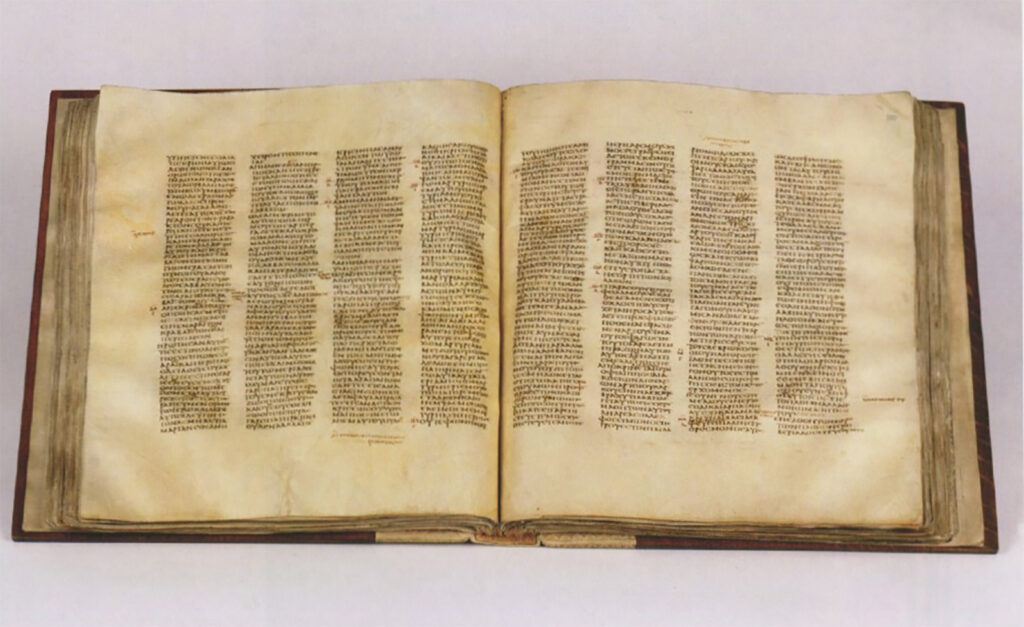
This section walks the reader through a series of transitions in the Codex Sinaiticus. Transitions between the Codex Frederico-Augustanus pages (located at the Leipzig University Library), and the bulk of the pages located at the British Library. Distinct colour differences are notable between the two collections.

Comparison with Other Manuscripts
This page brings an image of Codex Sinaiticus together with images of six other manuscripts of antiquity for visual comparison of the parchment, and the quality of the text. While comparing the aging of the parchments, note the abundance of corrections in Sinaiticus beside the relative absence of corrections in the other manuscripts.

Colour Variability
The British Library pages of Codex Sinaiticus not only tend to be darker and yellower than the Leipzig pages, but they are also much more variable in colour. The Codex Sinaiticus Project website, in a page dedicated to the parchment assessment, presents this composite of four photos to show the variability of colour among the British Library pages.

Historic Observations
Russian Orthodox Bishop Porphiry Uspensky described the Sinaiticus manuscript in the 1856 book, detailing his 1845 visit to St. Catherine’s Monastery at Mt. Sinai. Polymath N. A. Morozov, whose writings became a foundation stone for all followers of alternative history and new chronology, had his own view on Tischendorf’s activities.

Modern Observations
“One of the things that we found is that the parchment, which is 1600 years old, is in phenomenally good condition. It’s very very, very fine parchment. The animal husbandry that there must have been in order to produce such parchment is incredible, absolutely incredible".

Ink Issues
Differences in the inks examined, taking for comparison images from two different pages in the Leipzig University Library collection.

The Smoking Gun?
Much of the evidence presented on Sinaiticus.org is proof of someone tampering with the manuscript (colouring and ageing it) and observations that refute the purported age of the manuscript, and refute the story told by Constantin Tischendorf. Do we have conclusive proof that Contantine Simonides was involved in the production of the manuscript that became Codex Siniaticus?

Homeotelution
Homeoteleuton (homoeoteleuton) is in general terms, the use of word endings that are similar or the same during the copying of text. For our purpose, an error in copying the text is made because of the similar word endings. We show a number of examples of homeoteleuton found in Codex Sinaiticus, that we believe clearly identifies the exemplar text for part of the manuscript.

Special Points of Interest
This page presents images of special points of interest found while examining the images of Codex Sinaiticus. They are images that raise questions or provide special insight regarding the origin and history of the manuscript.
